
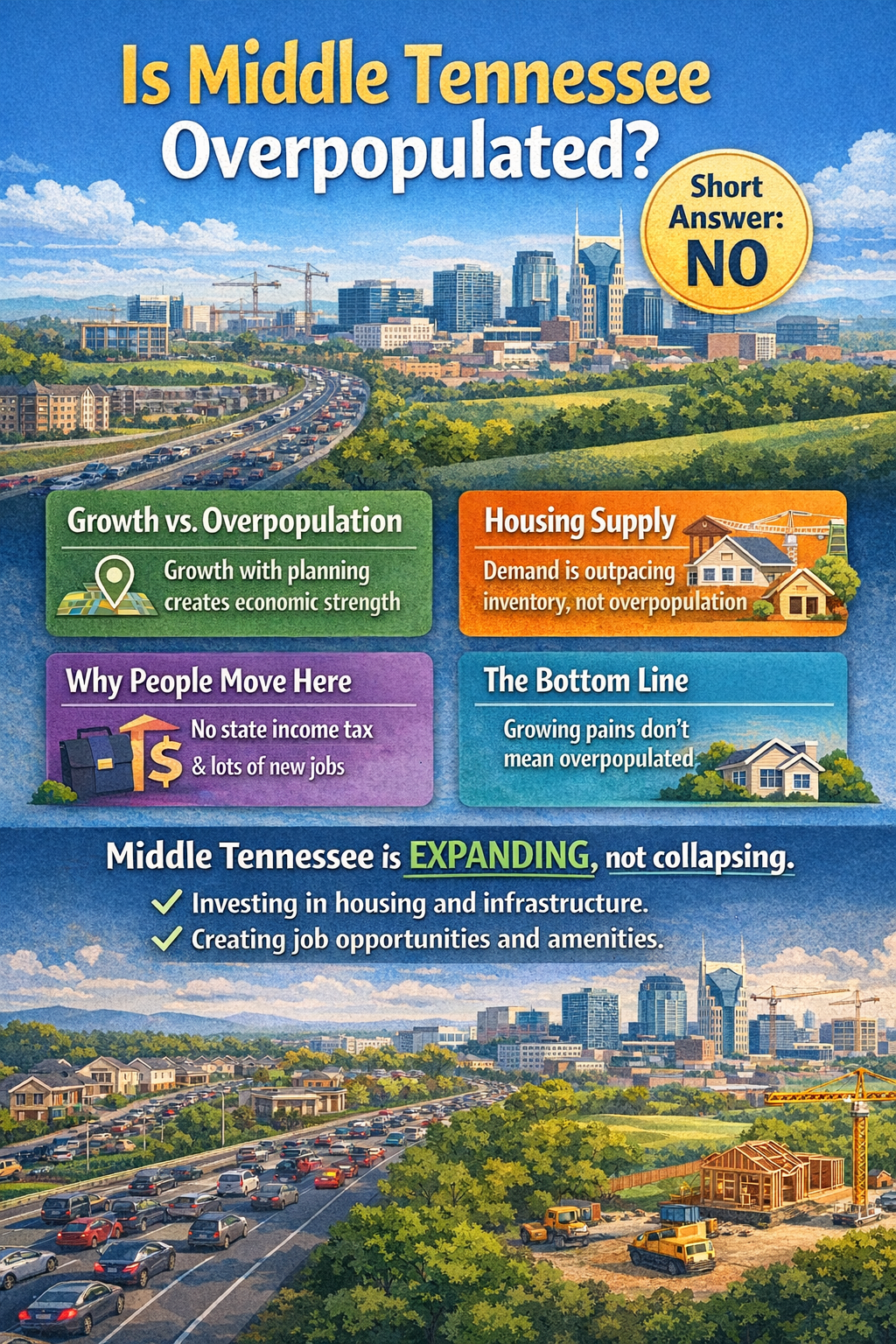
Is Middle Tennessee Overpopulated?
It can feel that way.
Traffic on I-24.
New subdivisions in Lebanon.
Apartments rising in Mt. Juliet.
Nashville cranes everywhere.
So the question is fair.
Is Middle Tennessee overpopulated?
Short answer: No.
Long answer: It is growing fast, but growth and overpopulation are not the same thing.
Growth vs. Overpopulation
Overpopulation means infrastructure and housing cannot keep up with demand.
Middle Tennessee is experiencing:
-
Strong in-migration from other states
-
Corporate relocations
-
Healthcare and logistics expansion
-
Continued job growth
That creates pressure. But it also creates opportunity.
Growth without planning creates problems.
Growth with planning creates economic strength.
The region is expanding outward, not collapsing inward.
Where the Pressure Is Showing
There are real stress points:
-
Traffic congestion in parts of Nashville and Rutherford County
-
School capacity in fast-growing suburbs
-
Infrastructure catching up to population increases
Those issues are growing pains, not systemic failure.
Look at Wilson County, Rutherford County, and surrounding areas. Development is spreading, not just stacking density into one core.
Housing Supply Is the Real Issue
What many people call “overpopulation” is actually:
A housing supply imbalance.
For years, the region underbuilt relative to demand. When migration increased, inventory tightened.
That drove:
-
Higher prices
-
Rental increases
-
Faster absorption of listings
That is not overpopulation. That is supply lag.
Why People Keep Moving Here
Middle Tennessee continues to attract residents because of:
-
No state income tax
-
Job growth across multiple sectors
-
Relative affordability compared to coastal markets
-
Central location in the Southeast
Population growth tends to follow economic opportunity. And Middle Tennessee continues to create it.
What This Means for Buyers
If you are considering buying:
-
Growth supports long-term housing demand
-
Expanding suburbs create new entry-level options
-
Infrastructure investment tends to follow population
Waiting for population to slow dramatically may not be realistic.
The region’s long-term trajectory remains strong.
The Bottom Line
Middle Tennessee is not overpopulated.
It is expanding.
There are pressures. There are traffic frustrations. There are construction zones.
But those are typical in regions experiencing economic strength and migration.
For buyers, the real question is not whether the area feels crowded.
It is whether long-term growth supports long-term value.
And right now, the fundamentals suggest it does.